

Equity Perspectives- Third Issue 2026
Latest market updates from the United States, Europe/UK, and HK/China


📑HK / China Updates

📑US Updates

📑Europe/UK Updates

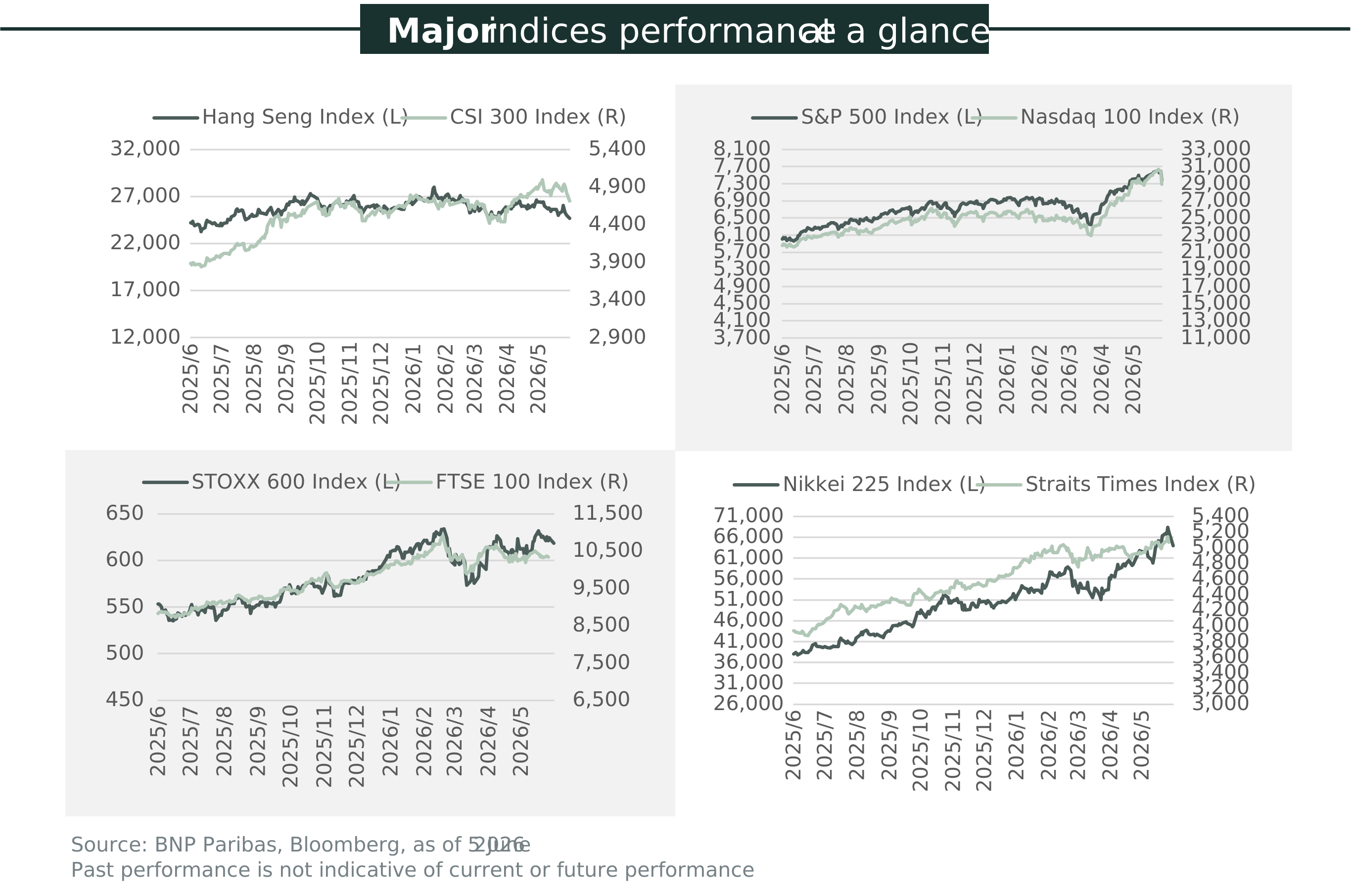
Market Snapshot

- Since our April 2026 update, AI-driven optimism has propelled global equity markets, with indices in the US, South Korea, and Japan reaching record heights.
- While the momentum remains strong, we advise prudent positioning as we enter the second half of 2026. We recommend adding AI-centric stocks in stages given their outsized performance year to date.
- Additionally, we also expect added volatility in the near term as markets await potential high-profile IPOs from OpenAI and Anthropic. These listings could divert liquidity away from existing equities.
- We maintain our constructive stance on industrials, favouring electrical and power equipment providers which are well-positioned to benefit from AI demand. We also see opportunity for patient investors to accumulate quality defence names which have lagged but whose medium- to long-term prospects remain favourable.

Improving macro backdrops
What happened?
Benchmark stock indices of HK have underperformed most other developed markets year-to-date, partly attributable to the fact that high-flying tech companies are underrepresented. For instance, the Hang Seng Index is heavily anchored by financials and consumer discretionary, whilst Hang Seng Tech Index is interestingly dominated by consumer discretionary and communication services companies instead of those in information technology sector. On the other hand, FactSet China Semiconductor Index soared 45% year-to-date (as of 5 June 2026).
Our thoughts
- We continue advocating a barbell strategy that overweighs promising high growth and resilient high dividend. We believe promising high growth companies are mostly likely from industries that will enjoy unequivocal policy tailwinds, such as semiconductor, AI, new battery and biotech. On the other hand, our screening criteria for resilient high dividend include track-record of rising dividend and low debt-gearing.
- One may point out that market breadth of HK China market has narrowed dramatically, but that is also the case for many other stock markets across the globe so far in 2026.
- China seems to have exited a multi-year deflationary period, as evidenced by Producer Price Index (PPI) rising 2.8% year-on-year (YoY) and Consumer Price Index (CPI) rising 1.2% YoY in April 2026. In a reflationary environment, companies benefitting from higher sales prices and/or the anti-involution campaign are likely to outperform.
- Recent regulatory tightening sparked worries about potential slowdown in cross-border capital flows, though we expect the news flow will cool market sentiments temporarily only. On 22 May 2026, China Securities Regulatory Commission (CSRC) fined three internet brokers in Hong Kong for providing cross-border services in mainland China. This action was echoed by the Hong Kong Monetary Authority (HKMA), which requested that Hong Kong banks review existing investment accounts owned by mainland Chinese clients. In June, CSRC vowed to strengthen market fairness and standards, with targeted supervisions and to firmly crack down market manipulations.
How to play the game?
🎯Areas on our radar: Details of new policies in accordance with China’s 15th Five-Year Plan, shift from entrenched deflation to mild reflation, interest rate forecasts.
🔎Investment implications: Emerging industries highlighted in China’s 15th Five-Year are expected to meet new favourable policies. Selected consumer brands which have pricing power.
Notable Developments in Selected Sectors
- Financial Services: China Securities Regulatory Commission (CSRC) recently said the fund industry shows compliance gaps and imbalanced development. The regulator pledged to deepen public fund reforms, enhance compliance, and prioritise investor interests through regulatory measures and strategic initiatives.
- Macau Gaming: Tightening controls over outbound investments by mainland China is likely to weigh on sentiment towards Macau gaming, in addition to slowing gross gaming revenue growth in recent months.
- China Auto: New car sales showed signs of recovery, with mass market-oriented original equipment manufacturers (OEMs) saw 13% sequential growth in May. Order volume rose as OEMs have launched more models in their 2026 lineup.

Tech & AI resurgence, market awaits potential mega-size IPOs in coming months
What happened?
Further to our earlier update where we had written on tactical opportunities emerging in US equities amid more reasonable valuations after March’s selloff, US equities and Tech sector have rallied, driven by AI narratives. For H2 2026, we expect continued choppiness as the market awaits potential mega size IPO announcements from key AI startups.
Our thoughts
- Recent Q1 2026 corporate earnings releases have been stronger than expected, contributing to firmer investor confidence as AI capex commitments were affirmed, which has led to further earnings forecast uplifts and a more buoyant equity market over the past two months as geopolitical uncertainties eased.
- As of 2 June 2026, FY26E & FY27E earnings growth forecasts for MSCI US have increased to 23.3% & 17.4% respectively, outpacing MSCI World’s 20.6% & 14.9% (source: Institutional Brokers’ Estimates System (IBES) estimates).
- US tech sector returns have seen a stellar catch up over the past two months spurred by improved confidence in the AI theme. This has driven further rallies in semiconductors/memory and select IT hardware stocks amid tight demand/supply dynamics, which are expected to extend into 2028E given the ongoing data centres build-up, underscoring the higher earnings visibility for AI infrastructure players at this point in the cycle. However, we caution that investors considering fresh entries should consider adding positions in stages after the strong rally.
- Within Tech, we continue to advocate a more nuanced approach to owning Software stocks given time needed for the sector to disprove disruption worries. Our picks have been focused on quality software and cybersecurity leaders with large installed bases, multiple products offering and seeing encouraging progress in their AI initiatives, some of which have rebounded strongly this quarter.
- We maintain our constructive stance on Industrials, a diverse sector of twenty sub-industries. Within this sector, we continue to favour electrical and power equipment providers which are well positioned to benefit from the increasing demand for electrification amid the current AI data centres buildout phase. With recent market flows rotating to AI plays of late, we see fresh opportunities for patient investors to accumulate Aerospace & Defence blue chips which have lagged but whose medium-term growth prospects remain favourable.
How to play the game?
🎯Areas on our radar: Hyperscaler capex plans, economic growth trajectory, Fed rate decisions
🔎Investment implications: Maintain prudence and diversification, favouring quality firms with healthy balance sheets.
Notable Developments in Selected Sectors
- Information Technology – Market has turned increasingly bullish on AI buildout with all 3 memory leaders now crossed the USD1T market cap. The AI sector has extended its powerful rally, reinforcing our view to stay diversified and backing quality sub-segment leaders. We remain focused on capturing the secular AI trend through high quality market leaders.
- Energy – Oil prices continue to exhibit significant volatility, primarily driven by geopolitical developments in the Middle East. Amid these challenges, the sector has demonstrated resilience and emerged as a top-performing segment during the ongoing conflict. Even in the event of a substantive ceasefire agreement involving Iran, we anticipate a higher-for-longer oil price environment. This outlook suggests that sector cash flows will remain robust. However, given the scale of outperformance, the sector has been downgraded to Underweight, and we prefer to be selective among sector names.
- Industrials – We remain constructive on electrical and power equipment providers within the sector in view of the presence of various asset heavy firms that should continue to benefit from the current AI buildout which is fanning demand growth for grid modernisation, electrification and power management.

Feeling the heat this summer?
What happened?
European equities navigated a turbulent spring, alternating between geopolitical relief and inflation fears. At the same time, our Underweight view integrates the risk associated of a prolonged Iranian conflict.
Our thoughts
- The intensification of the Iran conflict and the Strait of Hormuz challenges led to a sharp spike in oil and gas prices, leaving Europe directly exposed to a longer-lasting rise in liquefied natural gas (LNG) prices. Europe tends to underperform during oil price shocks. Despite market uncertainty, the STOXX Europe 600 Index has shown resilience, bolstered by the valuation discount relative to the overly-exuberant US market. The earnings season was also supportive, with an average earnings’ beat rate of 55%, in line with history.
- The energy price shock poses a dilemma for monetary policy. Earlier hopes for rate cuts have been completely priced out. Instead, markets are anticipating interest rate hikes from the European Central Bank (ECB) to combat inflation.
- European equities experienced distinct divisions as investors sought shelter while still attempting to access growth. The global AI trade has continued to support Technology and Industrial names exposed to this trend. The banking sector, which was previously deemed favourable, struggled and dragged down index returns in markets like the UK.
- Some sub-sectors remain appealing over the longer term due to increased defence and infrastructure spending, underpinned by 2025’s German fiscal spending plan. European luxury names may have struggled due to a consumer demand slowdown and reduced activity in international travel hubs. But Chinese consumers are showing signs of renewed appetite for high-end products.
- Separately, the FTSE 100 has been rangebound in recent months, following a record high in February 2026 and a major pullback in March 2026. The UK has also had to navigate a challenging political environment, with Prime Minster Keir Starmer under pressure. The market remains reasonably valued, trading on 12.9x forward P/E for the FTSE 100 as of 8 June 2026, though we have downgraded the market to Neutral.
How to play the game?
🎯Areas on our radar: AI-adjacent names continue to benefit from global trends; front-end loaded fiscal and defence spending in 2026.
🔎 Investment implications: Semiconductors, infrastructure and defence spending to become key driver of opportunities, given the lower support from monetary policy.
Notable Developments in Selected Sectors
- Utilities: Rising power demand growth, particularly for data centres, helps underpin the investment thesis. Several names are aligned with structural tailwinds, with decarbonisation trends and increased demand for energy security and independence supportive. Utilities have shown robust performance, particularly in power generation and networks.
- Healthcare: While European Healthcare stocks have seen investor rotation toward AI-driven sectors, their defensive qualities and long-term growth potential make them a strategic portfolio addition. With aging demographics driving demand and undemanding valuations, Healthcare provides both downside protection and diversification benefits for portfolios overly tech.
- Industrials: Capital goods names remain well-positioned for structural growth in data centres and utilities, two key end-markets underpinned by secular trends like AI expansion, electrification, digitalisation, and the energy transition. The sector also stands to gain from rising defence spending in Europe,. However, near-term challenges, including order delays, and evolving defence priorities, may temper performance. This suggests more measured expectations in the short term.


Please read carefully the disclaimer here: https://wealthmanagement.bnpparibas/asia/en/disclaimer1.html